
Love, Liberty and the ‘Lust-Loving Parson’: Thomas Webbe of Langley Burrell
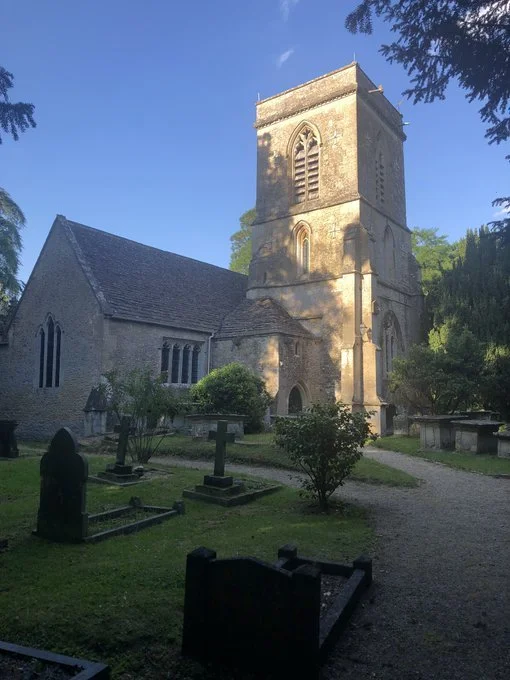
Langley Burrell parish church.
In 1647, during the chaos of the English Civil War, a young twenty-something former hatmaker named Thomas Webbe became minister of Langley Burrell, Wiltshire. What followed was one of the most remarkable examples of sexual liberty in 17th-century England, remarkable not just for its defiance of convention, but seemingly for its brief, extraordinary acceptance.
Webbe arrived in the village preaching radical ideas about personal spiritual experience over organised religion. He promised his parishioners he would not demand tithes, the local tax that provided income for the minister. And, most controversially, in his teachings, he encouraged liberty and freedom in relationships among his followers, whether male or female, married or not. As a result, John Aubrey, himself no prude, wrote: 'There was such blasphemy and uncleanness…in after ages 'twill scarcely be believed', alluding to the notorious Bacchanalia of ancient Rome—festivals of sexual excess so transgressive that the Roman Senate had banned them centuries earlier.
At the heart of this scandal, just outside Chippenham, was Webbe's openly acknowledged same-sex relationship with John Organ of Castle Combe, described in 1652 as a 'comely young man…of an honest stock and parentage'. Their relationship began when Webbe taught Organ to preach, but quickly deepened into something seemingly personal. Both men were married, yet neither denied their relationship. They embraced it publicly.
Magistrate Edward Stokes recorded their extraordinary openness: 'This man is taken by Tho. Webbe, as men use to take their wives, for better for worse: so, I say this man is honoured with the title of Webb's wife, for so he calls him, My wife O[rgan]; and O owns Webb for a husband.' This wasn't a hidden affair conducted in shame, but a relationship acknowledged with the language of marriage—in an era when homosexual acts were punishable by death.
The fact that Webbe and Organ's relationship was tolerated, even temporarily, speaks to the peculiar circumstances of the Civil War. Traditional ecclesiastical and civil authority had collapsed. In this vacuum, the manor house at Langley Burrell became a commune for Webbe's libertine sect, where conventional morality was suspended.
Webbe also conducted an adulterous affair with Mary White, wife of the local lord of the manor. Surprisingly, Mary's husband Henry appears to have remained on good terms with Webbe, even supporting his later self-justifying pamphlet. This was a community perhaps reimagining the boundaries of what personal relationships could be.
The scandal eventually caught up with Webb. Surprisingly, it wasn't the same-sex relationship that brought Webbe before parliament and the courts and lost him his living at Langley Burrell, but rather his affair with Mary White. Although acquitted of adultery charges in 1650, Webbe was ejected from his livelihood in 1651 after parliament heard evidence of his conduct.
Organ fled to Kent. Webbe and Mary faced legal action, including at the Old Bailey in 1654, their final appearance in official records. A Thomas Webbe died in Lambeth in 1665, possibly of plague. Intriguingly, a Mrs Mary Webbe died in the same parish.
Thomas Webbe's story reveals a brief moment when England's religious and political upheaval created space for radical sexual freedom—including what may be the only documented openly acknowledged same-sex marriage-like relationship of 17th-century England.
Louise Ryland-Epton