
Chippenham's Royal Wedding: The Birth of English Queenship
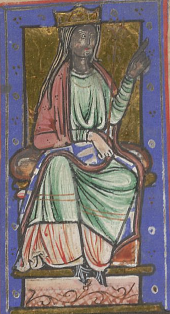
Chippenham's first appearance in history was as the setting for a royal wedding. In 853, Æthelswith, sister to the future King Alfred, married Burgred, King of Mercia, at the West Saxon royal estate at Chippenham. This is the earliest documentary evidence for Chippenham's existence. The fact that it was chosen to host one of the most important political marriages of the ninth century suggests that it was a significant royal residence.
The Anglo-Saxon chronicler Asser recorded that the wedding was conducted 'in royal style', a phrase that may hint at something more significant than a standard marriage ceremony. Remarkably, it was Burgred who travelled to Chippenham to collect his bride, meaning a Mercian king journeyed into Wessex, and again underlining Chippenham's importance as a venue for high-stakes diplomacy. Why Chippenham rather than Winchester or another major West Saxon centre? We can only speculate.
Æthelswith wielded extraordinary power for a Saxon queen that far exceeded that enjoyed by her West Saxon contemporaries. Mercia was surrounded by rival kingdoms and needed to maintain diplomatic alliances as much as military might. Royal wives from powerful families were crucial in establishing and maintaining those alliances. Æthelswith's position as sister to the future King Alfred gave her husband Burgred vital connections to Wessex. These connections proved crucial more than once. In the same year as his marriage Burgred needed help against the Welsh, and later in 868 he called on his brothers-in-law for support against the Vikings.
At the Mercian court, Æthelswith was a major player, jointly issuing royal charters and acting as a witness for her husband in legal documents. Remarkably in 868 she independently granted fifteen hides of land at Lockinge in Berkshire to one of her ministers, describing it explicitly as her own property—making her the first English queen to own and manage land in her own right.
More striking is a charter from 869 that describes Æthelswith as ‘pari coronata stemma regali Anglorum regina’, the crowned queen of the Angles and of equal royal pedigree to her husband. This unique description suggests that Æthelswith may have been the first queen to be crowned and possibly anointed in England. If this ceremonial elevation took place at her wedding in 853, it would make Chippenham the birthplace not just of an important political alliance, but of English queenship itself. It suggests a shift in policy regarding the status of queens. Unfortunately, it was a policy that her brother Alfred would later reverse, famously claiming that West Saxons did not have queens.
Æthelswith was the last queen of an independent Mercia before it was incorporated into a new 'Anglo-Saxon' realm established by her brother Alfred. In 874, she travelled to Rome with Burgred, who was driven into exile by the Vikings. Burgred died shortly after their arrival. What happened next remains somewhat mysterious. Æthelswith may have stayed in Italy after Burgred's death, or she may have returned to Wessex—perhaps even to Chippenham—before travelling back to Italy later. One intriguing theory suggests she did return to Wessex, perhaps to advocate for her son. The historian Alex Woolf has proposed that Æthelred, Lord of the Mercians (who married Alfred's daughter Æthelflaed), may actually have been Æthelswith's son with Burgred. If true, Æthelswith's son ended up as a powerful but subordinate lord in the kingdom his mother had once ruled as queen.
Whatever the truth of her later years, Æthelswith died at Pavia, Italy, in 888, far from both the Mercian kingdom where she had wielded remarkable power and Chippenham where her extraordinary public life had begun. From Chippenham in 853 to Pavia in 888, Æthelswith's life traced the arc of ninth-century English history itself—from the height of Mercian power to its absorption into the new Anglo-Saxon kingdom that her brother Alfred created, which, under her great-nephew, would become what we now know as England.
Louise Ryland-Epton