
Ginger Beer & a Stuffed Cat
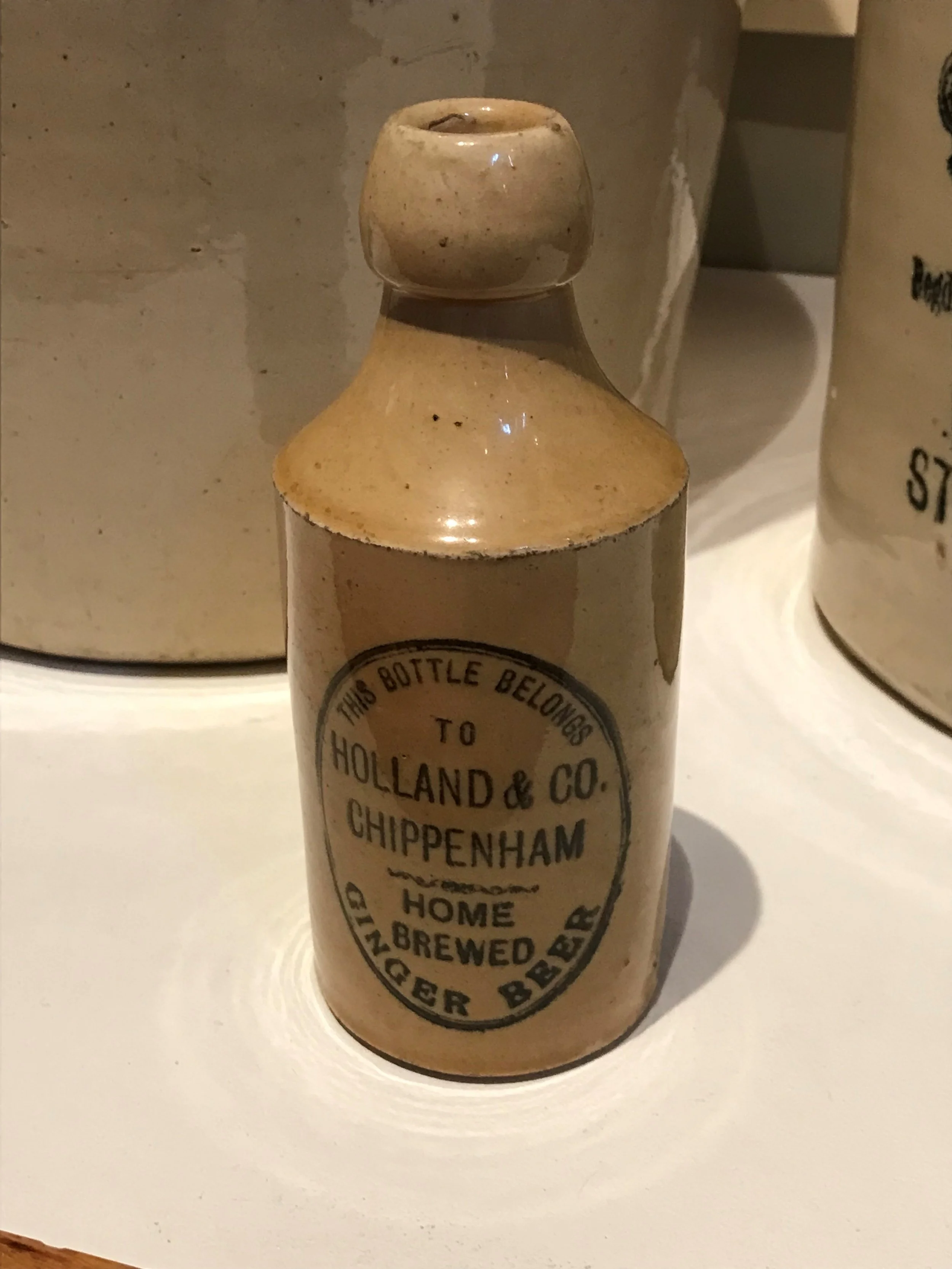
Holland ginger beer bottle similar to the one in Bagpuss, Chippenham Museum. Thanks to Alan Fuller for locating the bottle so that it could be photographed.
‘Once upon a time, not so long ago, there was a little girl, and her name was Emily . . .’ If you were, or had, a child during the 1970s or 1980s, you are probably remembering Oliver Postgate’s words as he introduced another episode of Bagpuss.
OK, so let’s rewind.
Once upon a time, very recently in fact, there was a grown-up part-time insomniac, worrying one night about how to make Chippenham’s history interesting. He was taking inspiration from a book written by a professor (his boss, actually), who had focused in detail on poems from various periods of English history to draw out from them general historical truths and themes about the times when they were written.
And he wanted to apply this technique to Chippenham, by looking hard at particular places in the town and seeing whether they could inspire people to understand its history. One of the places he had in mind was Chapel Lane, Gutter Lane as it used to be called, just off the High Street, where there was an interesting building that had been a school, and seems once to have been part of a ginger beer factory.
The chapter of the professor’s book that he read that night was about the medieval poem preserved at Reading Abbey, which begins ‘Sumer is icumen in’. It’s a song actually, a round, and the manuscript includes not just two sets of words, in English and Latin, but also the tune. There is a lot to be learnt about medieval culture, the professor explained, by comparing the version in Latin, which is a religious text about the crucifixion, with the English, which is a joyful, and slightly bawdy, celebration of Spring. All very edifying. But at the end, as a throwaway line, she mentioned that the tune to this medieval song was sung by the mice in Bagpuss when they set to work to mend something.
Now as one who neither was, nor had, a child during the 1970s or 1980s, Bagpuss had rather passed him by, so he reached for his tablet and watched an episode on Youtube. This was 4 o’clock in the morning, you understand. It was about restoring a ship in a bottle, and right at the end of the video he noticed in the background one of the many props that set the old-fashioned domestic scene. It was a stone bottle on which was clearly written: THIS BOTTLE BELONGS | TO | HOLLAND & CO | CHIPPENHAM | HOME BREWED | GINGER BEER.
Thank you, professor – his eureka moment!
He knew that it was quite easy to find out about ginger beer makers, for the simple reason that people liked to dig up and collect these old stone bottles (he used to have one himself, from Calne), and then would post online what they could research about them. And so it was. Francis Holland was the second of four ginger beer makers who had occupied the factory in Gutter Lane in succession over 80 years, 1873-1953. He was there from 1884 to 1904, but he had set up in business a few years earlier, in 1879, selling fish, poultry and greengrocery, from an adjacent shop in the High Street.
Holland was a litigious man. He immediately fell out with, and issued a summons against, his neighbour, also a greengrocer, ‘for using language likely to cause a breach of the peace by insulting Holland's vegetables’. The defendant was bound over for £5 to keep the peace (or was it peas) for a month. In 1886 Holland threatened to sue anyone who refilled his labelled bottles with their own ginger beer, but then five years later was found guilty of doing precisely that with bottles belonging to a firm from Bristol. Ginger beer was a surprisingly underhand business, apparently.
This must have been because ginger beer, and associated mineral waters, were immensely popular in late Victorian and Edwardian times, judging by the number of businesses making them; and the link with brewers, pubs and the temperance movement is clearly something to be explored further. Our insomniac historian, proud of his nocturnal discovery linking Gutter Lane in Chippenham to Bagpuss, was eager to find out more. Millions of children and their parents, he surmised, had been exposed to Holland’s Chippenham ginger beer through watching Bagpuss, even if they hadn’t noticed. Had anyone else in Chippenham ever spotted the connection?
So, next morning, he emailed the doyenne of Chippenham history, Lucy Whitfield, and asked her cautiously whether she knew much about the ginger beer and mineral water factory in Gutter Lane. He didn’t mention Bagpuss. She didn’t know much, she replied, and told him mostly what he had already found out. But then she added: ‘a Holland bottle turned up as a regularly used prop in the 1970s children's TV series Bagpuss’ – her daughter when about eight years old had spotted it.
He should have known better – an eight year old had beaten him to it. Bagpuss gave a big yawn and settled down to sleep.
John Chandler