
Celia Bodenham: Prioress, Politician, Survivor
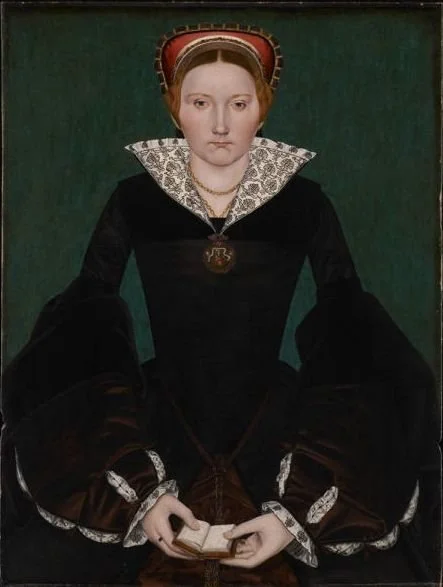
Allegedly a portrait of Celia Bodenham after the dissolution of Wilton Abbey in 1539.
In the spring of 1511, a curate from Castle Combe named Thomas Kelley robbed the small Benedictine priory of Kington St Michael and ‘caryd away the prioresse.’ We know this because Sir John Scrope, who owned the manor of Castle Combe, listed the episode among his grievances against Kelley in a petition to the Archbishop of Canterbury. Scrope described Kelley as a troublesome clerk and prayed to be recompensed for the ‘wrongful trouble and vexation’ caused by him, including for the abduction of the prioress. The prioress returned to Kington, presumably unscathed. The nun in question was almost certainly Celia Bodenham, and if the episode tells us anything, it is that Celia was a survivor.
Celia was the daughter of Roger Bodenham of Rotherwas in Herefordshire, and she became prioress of St Mary's Priory, Kington St Michael — just a few miles from Chippenham — around 1511. St Mary's was not a wealthy convent. Nonetheless, she enjoyed personal comfort, power, and influence held by very few women — or men — of her time. Celia had her own apartment, comprising several rooms in the west range, situated away from the other nuns (whose cells occupied the east range) but adjacent to the guest lodging, so she could entertain distinguished guests. Celia had servants to provide for her personal needs, a chaplain to serve the spiritual requirements of the community, and a steward to administer the priory’s estate, which was highly important to the local economy. Under Celia’s direction, the convent also served as a place of learning for girls and young women. According to John Aubrey, girls were taught to read, write, draw, and practice physic and surgery to heal the sick and injured. The nuns ministered to the local sick and gave alms, and Celia had the important right to choose the rector of the parish church. A century after she left, her family coat of arms was still visible in several rooms of the decaying priory buildings, and her portrait in nun's garb — ‘given by herself’ — could be seen in a stained-glass window in the parish church chancel. She had made herself unforgettable.
But Celia’s ambitions extended well beyond Kington. An assertive woman with friends at court, probably including Anne Boleyn, she became godmother to a son of Edward Bayntun, who served as vice-chamberlain to five of Henry VIII's queens. Though nuns were supposed to remain cloistered, Celia would have been present at the christening — possibly at court itself. She also oversaw the defence of the priory's interests in the Court of Requests in London, pursuing the monks of St Augustine's Abbey in Bristol and the tailors' guild of Bristol for arrears of rent. In an era when women's voices were routinely dismissed in legal and political arenas, this was remarkable. Most remarkable of all was the right she exercised as prioress: to raise the gallows on behalf of North Damerham hundred (an ancient subdivision of a county). It was very unusual for a woman to hold this power, and it afforded Celia a status that few of her contemporaries — male or female — could match.
From Kington, in 1533, Celia secured election as abbess of the far richer Wilton Abbey in what was frankly described as a ‘thoroughly corrupt’ process involving her borrowing money, making bribes and utilising friends at court. Yet she took her place, was accepted by the nuns there, and brought at least one Kington nun with her — testament, perhaps, to the loyalty she inspired. At Wilton, Celia continued to resist attempts to keep the nuns strictly confined and leased some of the abbey's estates to family and friends.
It has been suggested that by 1533, Celia recognised that the religious turmoil set in motion by Henry VIII, including Henry’s divorce of Catherine of Aragon in the year she moved to Wilton, put the future of religious houses at risk. By moving to Wilton, Celia was better able to secure her future. She was right to do so. The priory at Kington was dissolved in 1536.
When Wilton Abbey was dissolved in 1539, Celia claimed she was ‘without father, brother or any assured friend’ — a plea that was, she knew perfectly well, patently untrue. But it worked. She secured an estate at Fovant and a pension of £100 a year, vastly more than the £4 given to her successor at Kington or the tiny pensions given to her nuns at Wilton.
In retirement at Fovant, Celia sheltered former nuns of Wilton and maintained a personal chaplain, continuing a quiet, quasi-religious life. Her will reveals that, despite her former vow of poverty, she died a wealthy woman — possessing gold, silver, jewels, and rich fabrics — but also a devout one. She asked for masses to be said for three years after her death, left money for the poor throughout that same period, and made a bequest to Fovant parish church, which appears to have funded the construction of a south aisle.
Celia Bodenham was a pragmatist and a politician, a woman who understood power and used it — and who managed, against considerable odds, to shape her own life on her own terms. She is, in every sense, one of Wiltshire's most remarkable women.
Louise Ryland-Epton